
A Philosophy of Love
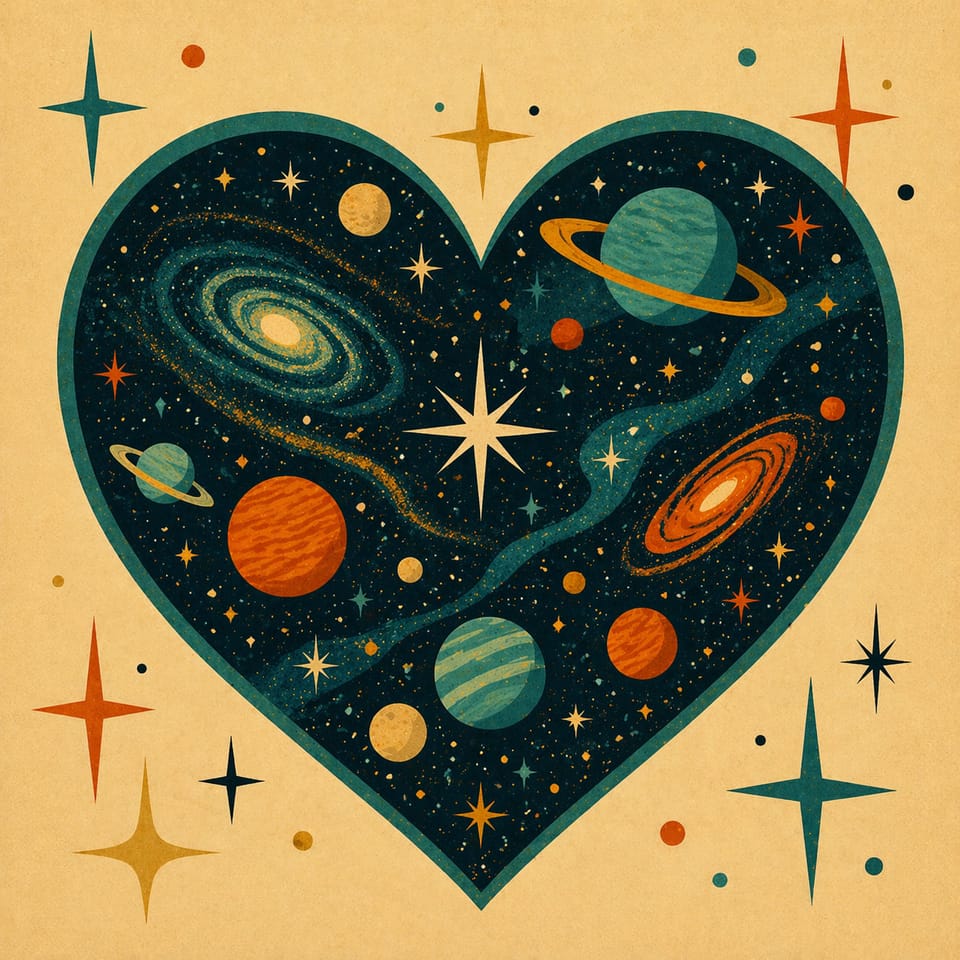
The universe is a strange, beautiful thing. Of course, it would be better if spiders didn’t exist. But the fact that it came into being—however you may believe it did—doesn’t change the magic of it all.
I sometimes think of the universe as an infinitely vast field—stretching outward and onward in all directions, including the direction of time. In it are black holes—concentrations of matter so dense, their gravitational fields are so powerful that they suck in everything around them—and other fantastical phenomena, including ourselves. The human tendency to view ourselves apart from nature, as opposed to being a part of nature, is a source of great confusion that often blinds us.
I sometimes think of us as the same classification of phenomenon as black holes—where our subjective experience is essentially the interior of our own minds’ event horizons, looking outward at all that comes flooding in. This would imply that everything we experience—the sounds, colors, feelings, etc.—comes from outside of us. Furthermore, this would imply that the universe is a constant swirling flux of raw sensation and, through the relational structure of our incidental environments, reaches our subjective experience in a structured way.
We are, in short, part of the universe that experiences the universe.
Everything great about existence and everything about ourselves necessarily all comes from the same source; in philosophical terms, it’s all of the same substance. In my experience, I have found that true happiness—a lasting contentment—comes from appreciating the universe as it is; not by denying facts about existence, but rather by living in harmony with them.
The mysteries of the universe inspire great awe, and I think it’s best to keep it that way. I don’t seek certainty anymore, and I revere my wonder about existence as sacrosanct and something that should not be supplanted by gross reductions to abstract systems of thought or simplistic terms.
Through my “philosophy” (if one can call it that), I’ve accepted not only the universe as it is but also myself. My appreciation of the “gift” (for lack of a better word) of existence led me to seek out other avenues by which I could appreciate it. I didn’t have to think about it: I instinctively knew that love and appreciation go hand-in-hand in some way.
And I fell in love with Jess. It’s a love so intense that I often forget about my philosophy—I’m always immersed in the present moment and have no need to think about anything else other than Jess and it’s fantastic. It’s only because Jess is at work right now that I’ve recalled the philosophy that led me to the greatest time of my life.
Because I had no need for philosophy once I met Jess, I haven’t really consciously thought of it in this way, but I suppose that by loving Jess, I am able to experience the magnificence of existence twofold through all the stories that she tells and the way that she enriches my daily existence. I am fortunate to wake up every morning and see a wonderful woman who has strived all her life to be the best that she can be, a woman who is beautiful in every way—a radiant manifestation of pure love from an incomprehensible source that is constantly unfolding into something greater day-by-day.
And maybe that’s what love really is: the universe recognizing itself in another form and wanting to stay close. Not needing to explain, reduce, or fully understand—just to witness, to appreciate, and to participate. In that sense, Jess is where everything fits—the place where this vast, strange, beautiful existence comes into focus. It isn’t just meaningful. It’s miraculous.